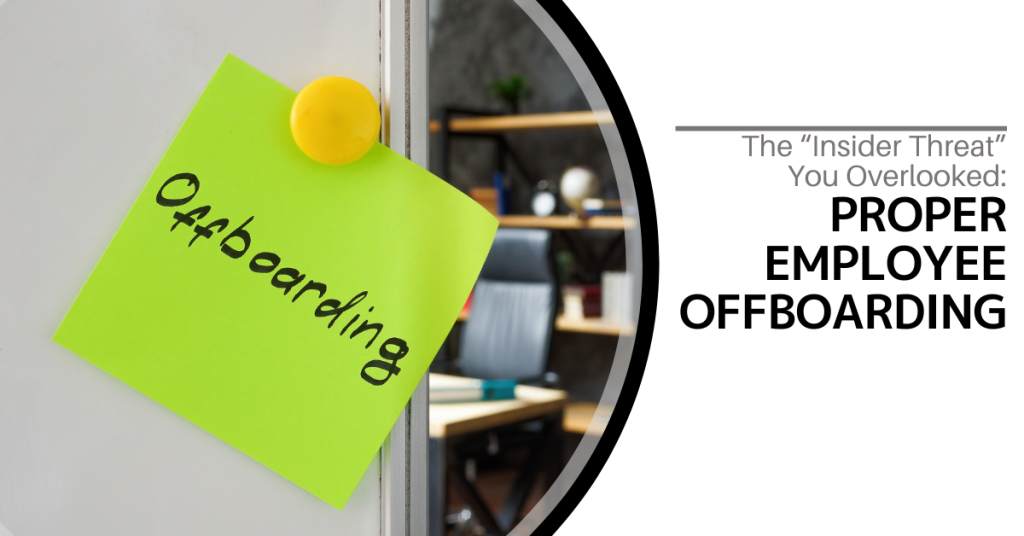
The “Insider Threat” You Overlooked: Proper Employee Offboarding
When an employee leaves your business, their access doesn’t leave with them — not automatically. Every login, every permission, every cloud account they touched remains active until someone deliberately revokes it. For small and medium businesses without a formal IT employee offboarding process, that window of exposure can last days, weeks, or even months.
Imagine a former employee — maybe someone who didn’t leave on the best terms. Their login still works, their company email still forwards messages, and they can still access the project
management tool, cloud storage, and customer database. This isn’t a hypothetical
scenario; it’s a daily reality for many small businesses that treat offboarding as an afterthought.
Many businesses don’t realise how much access departing employees still have. When someone leaves, every account, login, and permission they had must be carefully revoked. If offboarding is disorganised, it creates an insider threat long after the employee is gone. The
risk isn’t always malicious — often it’s simple oversight. Old accounts can become backdoors for hackers, forgotten SaaS subscriptions continue to drain funds, and sensitive data may remain in personal inboxes.
Failing to revoke access systematically is an open invitation for trouble, and the consequences range from embarrassing to catastrophic.
The Hidden Security Risks of Poor IT Employee Offboarding
A handshake and a returned laptop aren’t enough to complete offboarding. Digital identities are complex, and employees accumulate access points over time — email, CRM platforms, cloud storage, social media accounts, financial software, and internal servers. Without a proper employee offboarding checklist, something is bound to be missed.
Former accounts are prime targets for attackers. A breached personal credential might match an old work password, giving a hacker trusted access to your systems. The Information Systems Audit and Control Association (ISACA) notes that access left behind by former employees is a significant and often overlooked vulnerability. Overlooking this not only threatens your business data security but also increases compliance risk.
For South African businesses, this compliance risk is particularly concrete. Under the Protection of Personal Information Act (POPIA), your organisation is accountable for how personal data is accessed and managed — including access by former employees. A failure to properly de-provision user accounts could constitute a breach of POPIA’s security safeguard provisions, exposing your business to regulatory penalties and reputational damage
What a Bulletproof IT Offboarding Process Looks Like
A robust IT offboarding process is a strategic security measure, not just an HR task. It needs to be fast, thorough, and consistent for every departure — whether voluntary or not. The goal is to systematically remove a user’s digital footprint from your company through structured de-provisioning and access revocation.
This process should begin before the exit interview. Close coordination between HR and IT is essential. Start with a centralised inventory of all assets and accounts the employee has. You can’t secure what you don’t know exists.
Offboarding timeline: when to act
Timing is everything. Here’s the recommended action window:
- Immediately on departure: Disable primary login credentials, VPN, remote desktop access, and MFA tokens
- Within 24 hours: Revoke cloud app access (Microsoft 365, Google Workspace, Slack, CRM), reset shared passwords, retrieve company devices
- Within 72 hours: Audit access logs for unusual activity, transfer ownership of documents and active projects
- Within 30 days: Cancel or reassign SaaS licences, archive or delete the email mailbox, remove the user from SSO and identity management systems
Your Complete Employee Offboarding Checklist for IT Security
A checklist ensures nothing gets overlooked. It turns a vague intention into clear, actionable steps. Here’s a core framework you can adapt for your business:
- Disable network access immediately: Revoke primary login credentials, VPN access, and any remote desktop connections as soon as the employee leaves.
- Reset passwords for shared accounts: This includes social media accounts, departmental email boxes, and shared folders or workspaces.
- Revoke cloud access: Remove permissions for Microsoft 365, Google Workspace, Slack, project management tools, and other platforms. A single sign-on (SSO) portal makes it easier to manage access centrally.
- Reclaim all company devices: Have the employee return all company devices and perform secure data wipes before reissuing. Use mobile device management (MDM) to remotely wipe phones or tablets if needed.
- Forward emails: Forward the employee’s email to their manager or replacement for 30 to 90 days, then archive or delete the mailbox. Set an autoreply noting the departure and providing a new contact.
- Review and transfer digital assets: Ensure critical files aren’t stored only on personal devices, and transfer ownership of cloud documents and projects.
- Check access logs: Review what the employee accessed in the days before leaving, paying attention to any sensitive customer data downloads.
- Remove from identity and access management (IAM) systems: Ensure the user is fully de-provisioned across all connected applications — not just the primary directory.
- Cancel or reassign SaaS licences: Audit all software subscriptions the employee held. Reassign or cancel tools like Microsoft 365, Adobe, project management platforms, and any industry-specific software to prevent SaaS sprawl.
Offboarding Automation: Tools That Reduce the Risk
Managing offboarding manually across 10, 20, or 50 applications is unsustainable as your business grows. These tools and approaches can help:
Single Sign-On (SSO): Tools like Microsoft Entra ID (formerly Azure AD) or Okta allow you to de-provision a user from one central portal, automatically revoking access to all connected apps. This is the single highest-impact investment for access revocation at scale.
Mobile Device Management (MDM): Platforms like Microsoft Intune allow remote wipe and unenrollment of company devices, even after the employee has left the building.
Managed Service Providers (MSPs): Partnering with an MSP means you have a documented, tested offboarding runbook executed by IT professionals every time — not a rushed checklist handled by a non-technical manager on the employee’s last day.
→ Learn more about our managed IT services for SMBs and our guide to Microsoft 365 security best practices.
The Real Cost of Getting IT Offboarding Wrong
The consequences of poor offboarding are very real. Data exfiltration poses serious compliance and financial risks. A departing salesperson could walk away with your entire client list, or a disgruntled developer could delete or alter critical code repositories. Even accidental data retention in personal devices and accounts could violate POPIA or GDPR, leading to costly fines.
Beyond data loss, poor offboarding leads to financial leakage. Subscriptions to SaaS applications may keep billing the company long after an employee has left — this is known as SaaS sprawl, and when it accumulates, it takes a real toll on your bottom line. Even if the cost is small, it’s still a sign of weak IT governance.
Build a Company Culture of Secure Employee
Effective cybersecurity extends to how employees leave the company. Make the offboarding process clear from day one and include it in security training. This reinforces that access is a temporary privilege of employment, not a permanent entitlement.
Documenting every step is equally important. It creates an audit trail for compliance, provides proof if issues arise, and ensures the process is repeatable and scalable as your organisation grows.
Turn Every Employee Departure into a Security Opportunity
Treat every employee departure as a security drill and an opportunity to review access, clean up unused accounts, and reinforce your data governance policies. The goal is a thorough offboarding routine that closes gaps before they can be exploited.
Don’t let former employees linger in your digital systems. A proactive, documented IT offboarding process is your strongest defence against this common insider threat — protecting your assets, your reputation, and your peace of mind.
Ready to close your offboarding security gaps?
We help SMBs across the Western Cape implement automated, documented offboarding protocols that protect your data the moment an employee gives notice.
Contact 2KR IT Solutions today for a free security assessment.
Frequently Asked Questions
What is the biggest mistake companies make during IT offboarding?
The biggest mistake is delay. Failing to disable network and system access immediately creates a window of vulnerability for data theft or misuse. Every hour that passes with active credentials is unnecessary risk.
Does offboarding really matter if an employee leaves on good terms?
Absolutely. Even the most amicable departure poses a risk. Accounts can be hijacked, credentials can be leaked, and accidental data retention can still lead to POPIA or GDPR compliance violations. Process must trump trust.
What is the first IT step to take when an employee gives notice?
The first step is to inventory all their digital accesses and privileges alongside HR. This list drives the entire de-provisioning process and ensures nothing is missed.
How can we manage offboarding across many apps and SaaS tools?
Implement a Single Sign-On (SSO) solution. It provides a central portal where disabling an account revokes access to all connected apps and services simultaneously, eliminating the risk of missing individual platforms.
How long does a proper IT offboarding process take?
The initial access revocation should happen within minutes of an employee’s departure. Full de-provisioning — including device recovery, SaaS licence reassignment, email archiving, and access log review — typically takes 24–72 hours when following a documented checklist. Without a formal process, it can take weeks, leaving your business exposed.
What is SaaS sprawl and why does it matter during offboarding?
SaaS sprawl refers to the accumulation of software subscriptions across a business, many of which go untracked. During offboarding, unreviewed SaaS accounts mean former employees may retain access to business tools, and the company continues paying for unused licences. A proper offboarding checklist includes a full SaaS audit to cancel or reassign every subscription the departing employee held.
Contact us today for a free assessment